



Afghanistan asserted their growing stature in international cricket by lifting the ODI tri-series trophy in Sharjah on Thursday, delivering a clinical performance to dismantle Zimbabwe by seven wickets in the tournament final. The victory was the culmination of a dominant campaign throughout the competition, during which Afghanistan displayed exceptional discipline with both bat and ball, complemented by an athletic and reliable fielding display that ultimately left their opponents with no room to maneuver.
After winning the toss, Zimbabwe opted to bat first in the hope of setting a competitive total on a surface that promised to be challenging. However, they were unable to navigate the probing accuracy of the Afghan bowling attack, eventually folding for 169 in 43.3 overs. Afghanistan’s chase was a masterclass in composure; they navigated the target with significant ease, reaching 170 for 3 in just 34.3 overs to secure the title with 93 balls remaining.
A Masterclass in Bowling and Fielding
The foundation for Afghanistan’s victory was laid early by their potent bowling unit. The pace trio of Fazalhaq Farooqi, Bilal Sami, and Azmatullah Omarzai, combined with the wily spin of Mohammad Nabi and the world-class expertise of Rashid Khan, ensured that the Zimbabwe batting lineup never found its rhythm.
Farooqi set the tone by removing Tadiwanashe Marumani early, while Omarzai showcased remarkable reflexes in his follow-through to dismiss Brian Bennett. The fielding, often a point of difference in such high-stakes matches, was highlighted by a spectacular one-handed catch from AM Ghazanfar at short square leg, which accounted for Tafadzwa Tsiga. By the time Sami claimed the wicket of Brendan Taylor in the 13th over, Zimbabwe had spiraled to 55 for 4, effectively signaling the collapse of their top order.
Rashid Khan, who finished with impressive figures of 3 for 41, once again proved to be the centerpiece of the Afghan attack. His performance was statistically significant, as he became only the second bowler in ODI history to claim at least three wickets in six consecutive innings. Rashid’s spell was particularly lethal in the middle and latter stages; he trapped Brad Evans lbw before clean-bowling Newman Nyamhuri with a delivery delivered from an unconventional position behind the popping crease. He later accounted for the dangerous Sikandar Raza, who had been the lone pillar of resistance for Zimbabwe.
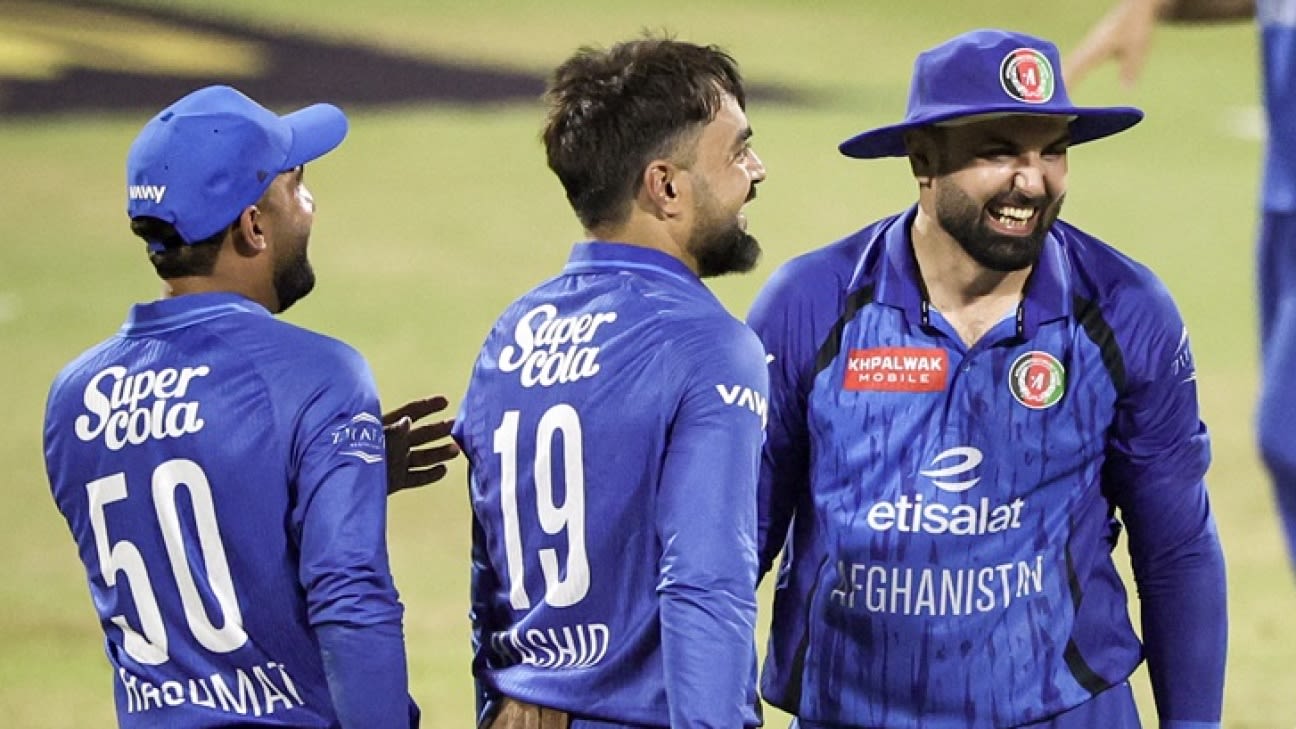
Mohammad Nabi also etched his name into the history books during the match. The veteran all-rounder picked up 2 for 25, his second scalp being that of Wessley Madhevere, who was stumped brilliantly by Rahmanullah Gurbaz. The dismissal was a testament to Gurbaz’s alertness; the ball had deflected off the batter’s pad, but Gurbaz collected it cleanly while moving away from the stumps and dislodged the bails in a single, fluid motion. This wicket marked Nabi’s 300th international dismissal across all formats, a landmark achievement for one of the sport’s most reliable all-rounders.
Sikandar Raza’s Valiant Stand
Despite the collapse around him, Zimbabwe captain Sikandar Raza produced a gritty, fighting innings of 68. Facing a difficult situation, Raza focused on rotating the strike and building a partnership with Ryan Burl to navigate the pressure of Rashid Khan’s opening spell. His effort was historic in its own right; at 40 years of age, Raza became the first batter in his age bracket to record a half-century in an ODI tournament final. Furthermore, he joined Allistair Campbell as only the second Zimbabwean captain to reach a fifty in a tournament final, the latter having achieved the feat against Kenya in 1997.
Raza’s innings included three fours and three sixes, the most memorable being a massive 98-metre strike over midwicket against Rashid Khan. However, his departure, caught at long-off while attempting another aggressive stroke, signaled the inevitable end of Zimbabwe’s hopes. The tail offered some late resistance, with Wellington Masakadza and Blessing Muzarabani managing a 32-run partnership for the final wicket, which lasted nearly ten overs and prevented an even more catastrophic total. Ultimately, however, the target of 170 proved far too modest for a confident Afghan batting lineup.
A Clinical Chase to the Trophy
Afghanistan’s reply was characterized by an aggressive start and a calm, calculated finish. Opener Ibrahim Zadran, who anchored the chase with an unbeaten 70 off 96 balls, ensured that there were no hiccups during the pursuit. Zadran struck four boundaries and a six, providing the stability required to neutralize the new-ball threat from the Zimbabwean pace bowlers.
Rahmanullah Gurbaz provided the early impetus, striking a rapid 36 off 31 balls. His knock was filled with intent, featuring six boundaries—including two towering sixes launched over fine leg and down the ground. Although the dismissal of Gurbaz and Sediqullah Atal in quick succession briefly threatened to stall the momentum, captain Rahmat Shah joined Zadran to steady the ship.

The pair of Zadran and Rahmat Shah put on an 82-run partnership for the third wicket, effectively taking the game away from Zimbabwe. They demonstrated remarkable patience, at one point going 77 balls without a boundary, choosing instead to milk the singles and doubles with ease. This period of play highlighted the maturity of the Afghan batting unit, which refused to get drawn into unnecessary risks when the required run rate was well within their control.
Once the pair had settled, they unleashed a flurry of shots to accelerate toward the finish line. Rahmat Shah, who contributed a composed 43 off 63 balls, struck a crucial six over midwicket against Masakadza. By the time Rahmat was dismissed—caught at short midwicket by Burl with just eight runs remaining—the outcome was a formality. Hashmatullah Shahidi joined Zadran to complete the formalities, with Shahidi striking the winning boundary in the 35th over to spark celebrations among the team and their supporters.
For Afghanistan, this title win is a clear indicator of their evolution as a team capable of dominating not just with individual brilliance, but with a collective, disciplined approach. While Zimbabwe showed flashes of individual grit through Raza’s captain’s knock, they were ultimately outclassed in every facet of the game by an Afghan side that appears increasingly comfortable on the biggest stages of international cricket. As the players celebrated in Sharjah, it was clear that this victory was the result of a complete tournament performance, characterized by intelligent bowling, sharp fielding, and a clinical, measured approach to the run chase.





Comments (0)