


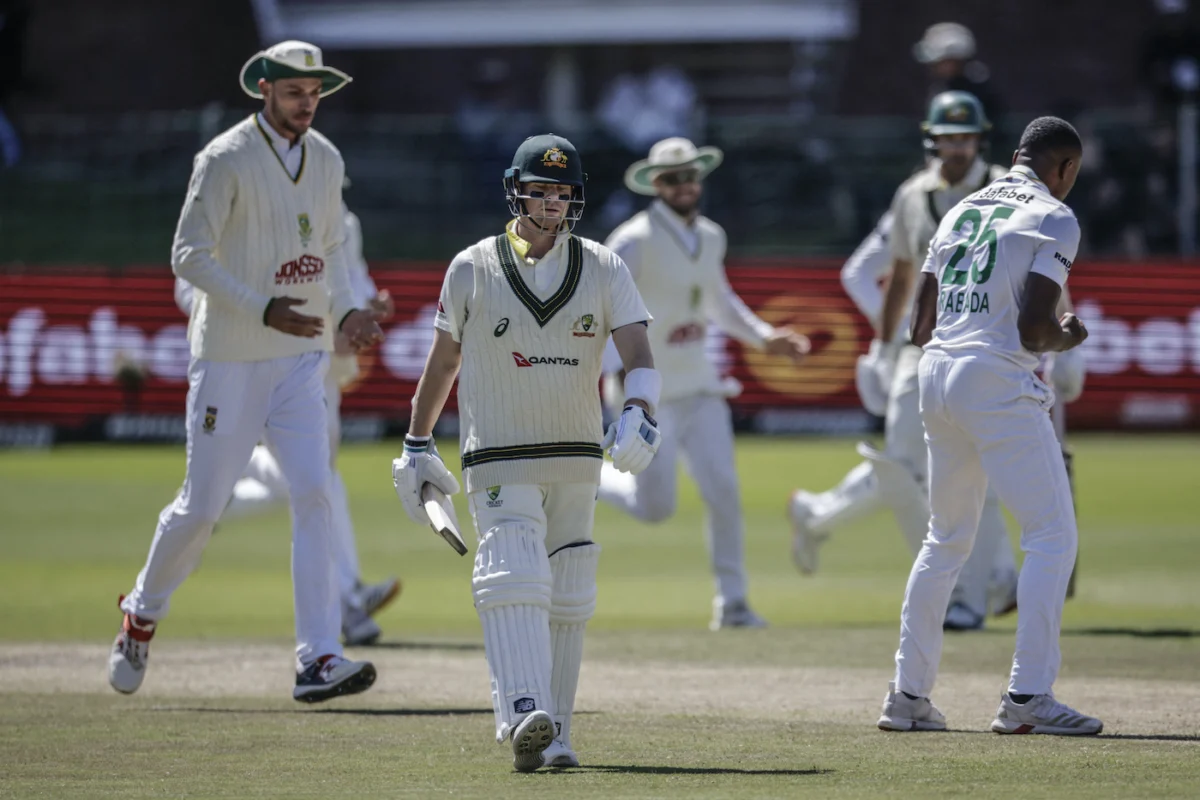
Australia is facing a period of intense soul-searching and a series of difficult questions over the coming days, with critical selection calls looming for the series-decider against South Africa following a crushing innings defeat in Gqeberha.
The dramatic reversal of fortunes could not have been more striking, swinging wildly from the opening outcome at Kingsmead to what ultimately transpired at St George’s Park. In the second Test, Australia found themselves forced to follow-on for just the third time since 1988. That humbling position arrived despite a commanding passage of play on the second day when they had reduced South Africa to 97 for 5 before persistent rain wiped out significant portions of the match schedule.
Captain Pat Cummins noted that the official inquest would not begin immediately, allowing the raw emotions of the heavy defeat to subside. Nevertheless, Australia will be forced to confront some stark home truths regarding their batting depth and execution after losing 19 wickets across just two days of play, all while preparing for a high-stakes, winner-takes-all contest at Newlands in Cape Town.
While the bowling attack has faced less sweeping criticism, it will not escape scrutiny entirely. The bowling group allowed South Africa to recover from a precarious position of 110 for 6 and surge to a formidable total of 425 for 9. Although Josh Hazlewood’s illness during the match was a notable factor, South Africa managed to absorb the impact of an injury to Anrich Nortje much more effectively. The hosts deployed a specialist spinner in Simon Harmer, whereas Australia opted to omit Nathan Lyon in favor of an all-pace attack. That strategy included the inclusion of Scott Boland, who claimed 5 for 81 and ultimately outshone several top-order batters with an impressive resistance with the bat.
Reflecting on the comprehensive defeat, Cummins admitted that the team fell well short of expectations. "We were nowhere near our best across the board really," Cummins said. "Clearly need to be a lot better than that if we want to compete. I think a loss can sometimes kick yourself into gear. You can maybe paper over the cracks sometimes in a win. Whereas I think in a loss, it makes you ask questions as a player of yourself."
The fragility of the Australian batting lineup was underscored by individual workloads during the second innings. After Travis Head compiled a resilient 121, the next most balls faced by any Australian batter in the Test belonged to Boland, who stubbornly survived 166 deliveries while serving as a nightwatcher. When questioned about comments made on SEN radio by former South Africa fast bowler Vernon Philander—who labeled Australia’s first-innings display, where they collapsed to 99, as "gutless"—and whether that assessment was fair, Cummins emphasized that the team must be prepared to dig deep and grind out tough runs in challenging conditions.
"Depends what that means really," Cummins said of Philander’s remark. "I think you’ve got to find a way in Test cricket. It’s not always going to be easy. You saw today with Trav and Scotty, sometimes it’s going to be about getting through the tough spells, sticking to your method and I think we went away from that on day four. You know, a couple of loose shots, [we] could have hung around and kind of waited for the game to come to us a little bit more."
The heavy defeat has placed three prominent players under significant pressure ahead of the final Test: the experienced Marnus Labuschagne, the recently recalled Nic Maddinson, and batting allrounder Beau Webster. On the injury and availability front, Cameron Green is expected to return and be available for selection for the final Test, though he will not be able to bowl due to his ongoing recovery. Meanwhile, Josh Inglis has also regained full fitness, and Cooper Connolly remains in the mix as an additional spare batter, alongside Sam Harper, who continues to travel with the squad.
Maddinson’s position at the top of the order is in serious jeopardy following scores of 0, 48, 0, and 8 since his surprise international recall. However, given Labuschagne’s vast experience spanning 67 Test matches, the impending decision regarding his place in the side shapes as the most significant and sensitive call for the selection panel.
On the fourth day of the second Test, Labuschagne was dismissed for 39 when he attempted to loft offspinner Simon Harmer down the ground into a howling gale, resulting in a catch at mid-on. That dismissal followed twin scores of 37 in Durban and 31 against Bangladesh in Darwin. Labuschagne has now failed to pass the fifty-run mark in his last 14 Test innings, though it is worth noting that during the current series, he has faced the third-most deliveries for Australia, trailing only Matt Renshaw and Travis Head.
"I think the hardest thing about opening or batting three is actually getting yourself in. [The] balls are normally doing a fair bit [and] you’ve got fresh bowlers. He’s actually doing the hard bit, he’s getting to 30," Cummins said of Labuschagne’s pattern of dismissals. "I think he’s got to find a way to turn those into bigger scores; 30s aren’t going to win you many matches. But it’s certainly not a technique error. It’s maybe a couple of decisions [when] the game demanded something a little bit different. So, again, we’ll work on that in the next couple of days. It’s one Test match left in the series, we’ve got to win this, and then there’s a bit of a break before the summer."
Despite maintaining an otherwise strong overall win record, Cummins candidly acknowledged that Australia’s batting lineup has not been functioning at an optimal level for quite some time. He pointed to the fact that they relied heavily on Matt Renshaw during the first Test, where Renshaw compiled 272 runs for the match and famously rescued the team from a dire position of 124 for 6 in the first innings.
"Even last week, obviously Renshaw had an amazing game but I still think we weren’t at our best, particularly in the batting," Cummins said. "Looking around the changing room at how good our batters are and the standards they all hold themselves to, I think we’re probably a little bit shorter runs of where we’d like to [be]. It’s [about] what do we look like at our best? We’re still finding ways to win, [but] I think we make it hard for ourselves sometimes. We’ve got three or four days to get it right for Cape Town. There’ll be lots of conversations."
At the same time, much like head coach Andrew McDonald expressed the night before, Cummins was careful to maintain a sense of broader context regarding the state of the tour and the quality of the opposition.
"If you said a month ago the series was going to be a one-all after two Tests with the two top teams in the world playing over here in South Africa, I think we probably would have said that’s not a bad position to be in," Cummins said. "It was only a week ago where we won convincingly. It doesn’t mean we’re a terrible team overnight."
Just as the old adage in politics suggests that a week is a long time, cricket has once again proven the same truth in a matter of days. The week ahead will undoubtedly prove hugely significant for the Australian team as they regroup in pursuit of a series victory.

Comments (0)