


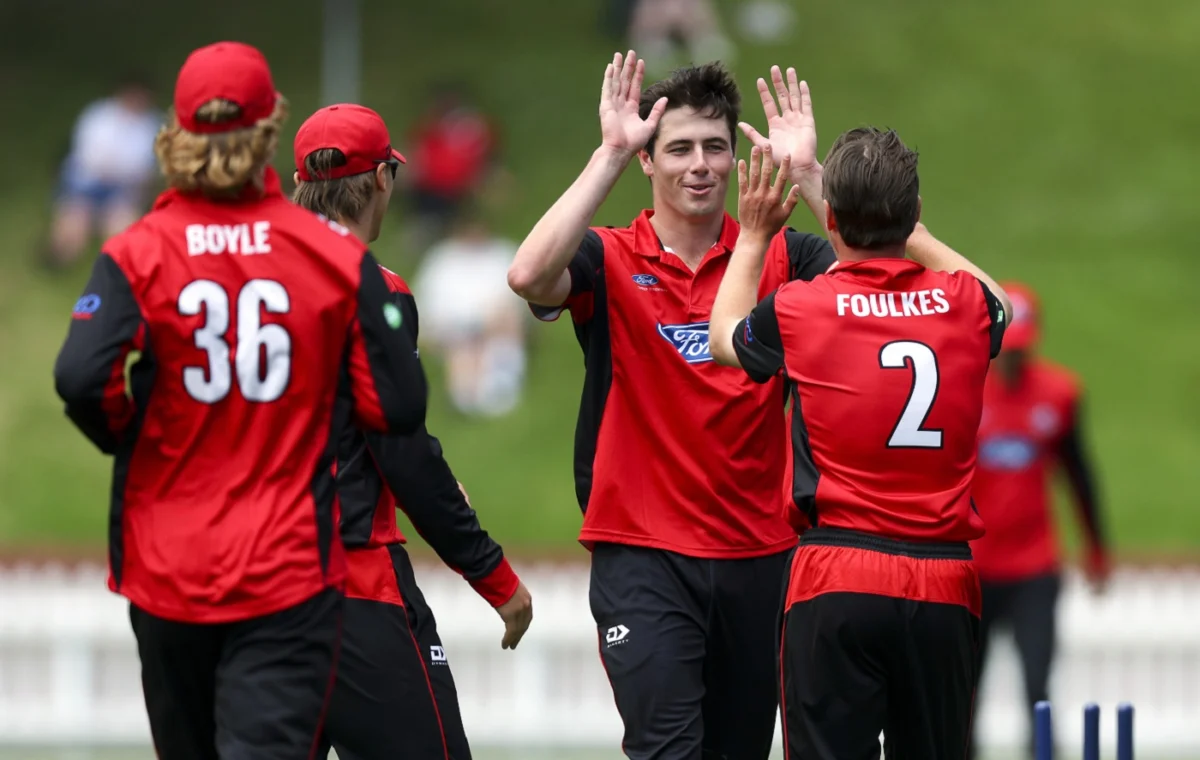
New Zealand Cricket (NZC) has announced a bold and innovative trial that could alter the tactical landscape of 50-over domestic cricket, confirming the return of the single-ball rule for the opening block of the upcoming men’s Ford Trophy. The trial, designed specifically to inject a traditional element back into the modern limited-overs game, will be implemented across the first five rounds of the 2026-27 domestic one-day tournament, which is scheduled to get underway on October 28.
Under the current standard playing conditions governing modern one-day international and domestic cricket worldwide, two new balls are used simultaneously from the start of an innings, with one deployed from each end. This two-ball rule has been the global norm for more than a decade, introduced by the International Cricket Council to ensure the ball retained its hardness and shine for longer periods, thereby encouraging stroke-play, reducing the frequency of discoloured balls, and providing television audiences with a visually appealing contest.
Specifically, under the existing regulations, the two new balls are utilized from the very beginning of a 50-over innings until the end of the 34th over. Once the 34th over is completed, the fielding team is required to select one of the two used balls, which is then deployed at both ends from the 35th over through to the conclusion of the 50th over. While this system has largely succeeded in maintaining a hard white sphere at the top of the innings and preventing excessive deterioration, it has also been widely criticized by traditionalists, fast bowlers, and coaches for effectively eliminating one of the most enthralling arts in fast bowling: reverse swing.
By using two separate balls that each only face 34 overs of wear and tear, neither sphere ever reaches the advanced state of degradation required to alter aerodynamics in a way that produces late, sharp reverse swing. As a result, the death overs in modern 50-over cricket have frequently devolved into a predictable procession of clean hitting and power-hitting, where bowlers struggle to restrict scoring once batters have established themselves.
In a direct bid to counter this phenomenon and give fast bowlers greater opportunities to extract reverse swing in the death overs, NZC has chosen to break with contemporary convention. For the first five rounds of the upcoming Ford Trophy, teams will use a single ball for all 50 overs of an innings.
The tournament itself features a distinctive structure, split into two separate blocks. The initial phase consists of the first five rounds running through October and November, after which the competition pauses. The remaining five rounds of the regular season, alongside the subsequent finals, are scheduled to take place in February of next year. Recognizing the experimental nature of the single-ball rule, NZC has built a formal review mechanism into the schedule. Following the conclusion of the opening five rounds, tournament organizers and cricket administrators will thoroughly evaluate the trial’s impact on the game, assessing factors such as run rates, bowler productivity, tactical shifts, and overall entertainment value. Based on these findings, NZC will make an informed decision on whether to persist with the single-ball approach for the second half of the season or revert to the standard two-balls-per-innings format.

The announcement has already generated significant discussion within the New Zealand domestic cricket community, drawing positive reactions from senior players who remember or appreciate the tactical nuances of an older era. Central Stags batter Will Young has voiced strong support for the initiative, suggesting that the trial injects a welcome layer of complexity and strategy into the 50-over format.
Reflecting on the potential impact of the rule change, Young noted that the return of a single, older ball fundamentally alters the dynamic between bat and ball, particularly during the game’s crucial final phase. He expressed enthusiasm for the prospect of reviving a lost craft and forcing batsmen to adapt their traditional strategies.
According to Young, the adjustment adds a genuinely interesting dynamic to the format, prompting players and coaches to rethink their approaches. He emphasized his personal enthusiasm for the idea of trialling a single ball and bringing back the art of getting the ball to reverse swing. He pointed out that with the ball deteriorating significantly more at the back end of the innings, batters will be vigorously challenged to figure out entirely different, innovative ways to maintain a healthy strike rate and keep the scoreboard ticking over. Furthermore, he noted that it will be fascinating to observe whether this single-ball experiment ultimately results in a fundamentally different style of playing or triggers a completely revised strategic approach to fielding restrictions and power plays.
The single-ball rule is not an entirely novel concept in the broader context of the sport, having formed the foundation of one-day cricket for decades before global governing bodies shifted toward modern innovations. The rule was a permanent fixture in international cricket until 2011, when the ICC formally transitioned to utilizing two new balls per innings—a regulation that underwent subsequent minor revisions over the years but remained the bedrock of modern limited-overs matches.
For players of Young’s generation and older fans alike, the prospect of watching a softer, scuffed-up white ball swing dramatically in the twilight hours of an innings evokes nostalgic memories of classic matches from the past. Young highlighted this historical connection, remarking that the trial reminds him of stumbling across old international highlights packages, observing death bowling where the ball is visibly softer and swinging in reverse, and noting how extraordinarily difficult it becomes for batters to score at more than a run-a-ball during those intense final 10 to 15 overs of an innings.
The opening round of the Ford Trophy promises immediate excitement as teams prepare to test these revised dynamics under competitive match conditions. The tournament kicks off with the Auckland Aces taking on Canterbury in Auckland, while the Central Stags clash with Northern Districts in Nelson. Meanwhile, logistical hurdles have necessitated a minor adjustment to the schedule; due to flight cancellations, the highly anticipated fixture between the Wellington Firebirds and the Otago Volts, originally scheduled for October 28, has been postponed by a single day and will now be played on October 29.
Beyond the immediate tactical intrigue of the single-ball trial, domestic cricketers across New Zealand will also have the opportunity to test their skills and adaptability under other recently revised playing conditions. These ongoing adjustments to domestic rules are being closely monitored with an eye on the 2027 ODI World Cup, which is scheduled to take place late next year, ensuring that New Zealand’s domestic players remain thoroughly prepared for the evolving demands of international white-ball cricket.




Comments (0)