



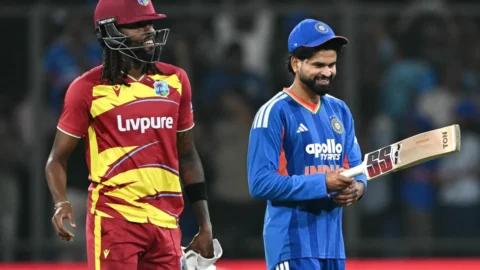
The remarkable limited-overs tour of India by the West Indies concluded in a damp squib on a wet evening in Bengaluru, where persistent rain completely denied the two teams a thrilling series decider in the fifth and final T20I. While the weather ultimately had the final say at the M Chinnaswamy Stadium, the premature end to the contest carried profound statistical significance. The washed-out fixture officially brought an end to India’s extraordinary 12-series winning streak at home, a dominant run that had stretched uninterrupted across four years.
Throughout the broader tour, the West Indies had repeatedly showcased their resilience and explosive white-ball capabilities. Even during the preceding One Day International series, which India ultimately claimed 2-1, the Caribbean side demonstrated their batting prowess by successfully chasing down a daunting target of 350 in the only match in which they got the opportunity to bat second. This competitive spirit carried seamlessly into the shortest format, setting the stage for a high-stakes finale in Bengaluru before the weather intervened.
The evening began with immense promise, largely due to the world-class drainage infrastructure at the M Chinnaswamy Stadium. The facility’s state-of-the-art systems allowed the ground staff to prepare the venue for action practically as soon as the initial heavy downpour subsided, enabling the officials to salvage a truncated nine-over-per-side contest. Upon winning the toss, the West Indies leadership opted to field first, inviting India to make the most of the compressed powerplay dynamics.
What followed was a breathtaking, albeit brief, exhibition of power-hitting from the Indian middle and top order. In just 7.4 overs of play before the heavens opened once again, India raced to a formidable total of 118 for the loss of 5 wickets. The onslaught was spearheaded by explosive cameos from Ishan Kishan and Naman Dhir, both of whom dismantled the West Indies bowling attack with sheer aggression. Kishan set the tone by dispatching two towering sixes during a blistering 10-ball knock of 30 runs, while Dhir added further momentum by clearing the boundary rope three times during an unbeaten innings of 24 runs coming off just six deliveries.
Tactically, the brief passage of play offered several notable talking points. In a surprising strategic move, the West Indies elected not to deploy Roston Chase, who had established himself as the leading wicket-taker across the course of the T20I series. Instead, the bowling load was shared among other options, with Shamar Springer emerging as the pick of the bowlers for the visiting side. Springer maintained composure amid the carnage to register impressive figures of 2 wickets for 17 runs from his 1.4 overs of work, effectively halting the Indian surge just before the players were forced back to the pavilions.
As the rain intensified and ground conditions deteriorated beyond recovery, calculations for a potential revised target under the Duckworth-Lewis-Stern method loomed large. Had the weather relented just enough to permit a five-over chase, the West Indies would have faced a revised target of 84 runs to secure a famous series victory.
Beyond the silverware, the shortened format would have carried major personal milestones for the home side. Most notably, a five-over scenario could have cleared the path for veteran fast bowler Bhuvneshwar Kumar to make his long-awaited return to international cricket. Having not featured for India since 2022, Kumar was poised for action, and under the specific playing conditions for a five-over T20 innings, where a single bowler is permitted to bowl a maximum of two overs, he might have been handed a vital spell to test his rhythm.
Ultimately, it was not to be, as the umpires had no choice but to call off the match and declare it a no-result, locking the series scoreline and finalizing the end of India’s historic home dominance.
Despite the frustration of the washout in Bengaluru, the global cricket calendar leaves little time for reflection. Following the conclusion of the weather-marred fixture, Bhuvneshwar Kumar and his teammates immediately transitioned to travel logistics. The veteran fast bowler was among the members of the squad scheduled to board a flight the very next morning bound for New Zealand, where India is set to begin a demanding new assignment featuring the first of a five-match T20I series.




Comments (0)