


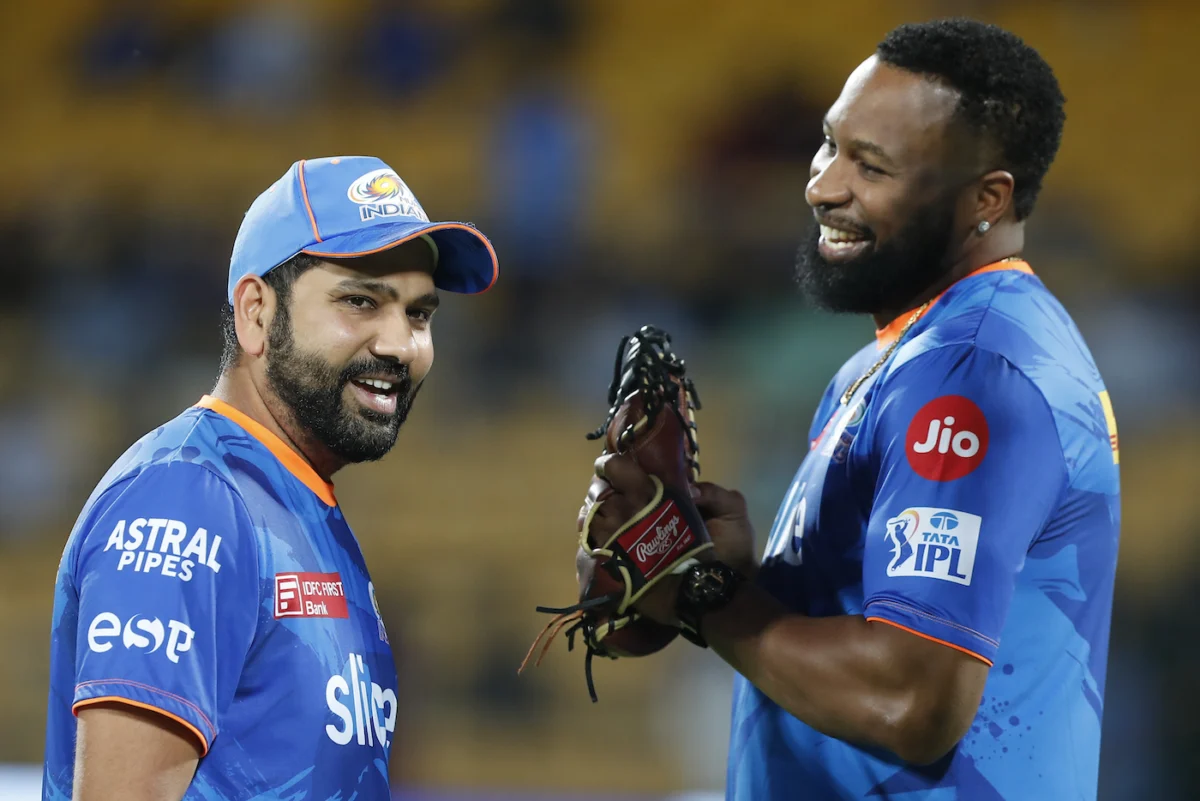
As the Mumbai Indians embark on a new chapter in their illustrious Indian Premier League history, newly appointed head coach Kieron Pollard has stepped into the role with a clear vision, a relaxed Caribbean mindset, and an unwavering resilience. Tasked with steering one of the tournament’s most successful yet recently struggling franchises back to glory, Pollard has made it abundantly clear that he is unfazed by the immense pressure that comes with the job.
Having officially transitioned into the top coaching position after previously serving as the franchise’s batting coach following his retirement from playing in 2022, Pollard is well-acquainted with the inner workings of the Mumbai Indians environment. However, taking the helm as head coach represents a significant step up, particularly given the team’s championship drought. Mumbai Indians have not lifted the IPL trophy since their triumphant campaign in 2020, and the franchise has cycled through different coaching setups in the years since.
Pollard, however, is eager to embrace the responsibility and inject fresh energy into the squad. Speaking about his new assignment, the former West Indian all-rounder highlighted the unique opportunity a head coach has to influence the team culture from the ground up.
"Most fun part is that you are able to set the tone in any environment for the team," Pollard said of his new task. "So that’s going to be fun. Being a Caribbean sort of guy, I think that is something, that fun and entertainment and relaxation is something that I’m big on, because then you’re able to perform when you are in that sort of zone. Obviously, the challenging part is going to be if results are not going your way. Nothing is going to sort of faze me."
The Mumbai Indians squad remains one of the most formidable and star-studded groups in the league on paper. The team features high-profile names such as Hardik Pandya leading the side as captain, T20 World Cup-winning captain Rohit Sharma anchoring the top of the batting order, and pace spearhead Jasprit Bumrah leading a lethal bowling attack. Despite this abundance of talent, Pollard’s primary challenge will be aligning these elite players and extracting their best performances to completely reverse the side’s fortunes after a string of underwhelming seasons.
Rather than relying solely on grand tactical overhauls or rigid team environments, Pollard believes that success is fundamentally rooted in interpersonal communication and individual accountability within the group.
"I think majority of it is man management," Pollard said when discussing how he plans to manage his players. "It comes down to conversations, one-on-one conversations. Yes, it comes down to the team talks and the team tactics. But cricket is made up of a group of individuals, who have to play a role in order for the team to win. So, it’s not always about what the team is going to do, but what you, as an individual and your role and capacity is going to give, to the team."
Pollard further emphasized that the most valuable work often happens away from the formal presentation slides and structured conference rooms. He pointed out that informal discussions are where players truly develop their understanding of the game and forge the chemistry necessary for a championship run.
"What over the years, what has brought success as well, is the time that you sit and you spend speaking about cricket outside of the formal meetings of a team meeting," he noted. "That’s where you learn majority of your cricket, and I think that’s where the work is really, really done."
Beyond man management and squad dynamics, Pollard faces a rapidly evolving tactical landscape in modern T20 cricket. Over the past few seasons, Indian pitches have witnessed a dramatic shift in scoring patterns, transforming the traditional benchmarks of a competitive total. Where a score of 140 to 160 was once considered defendable, totals of 200 have increasingly become the new normal, and targets upwards of 250 have been chased down with alarming regularity. Statistical trends highlight the sheer acceleration of the game, with totals of 225 or more having been chased down 11 times in the history of the IPL, including seven instances in 2026 alone and 10 since the 2024 season.
Pollard acknowledged these massive shifts in scoring and the stark differences between eras, noting that bowlers face an exceptionally difficult task in the modern game while emphasizing the importance of adaptability.

"It has changed a lot," Pollard said of the changing scoring trends. "It’s gone from 140, 160 being competitive to trying to not get 120 in the powerplay. So that in itself, should tell you how that landscape has changed. Yes, it has gotten more on the batter side, but it’s all good. I think one thing in life is change, and being able to adapt to change, and for us as a team and for myself as an individual, that’s the challenge. It’s never going to be the same, but being able to catch up with the evolution of where T20 cricket is going, or come up with methods where you can, as I say, slow the batsmen down. That means the bowlers will have to work doubly, doubly hard in order for that to happen. But again, the game is going fast, but we still have an opportunity as individuals to bring it back to a level and control what we can at different times."
In an era dominated by advanced analytics, performance trackers, and heavy data reliance, Pollard advocates for a balanced approach that respects numbers without sacrificing the instinctive flair of individual cricketers. Having worked closely with data analysts during his recent coaching tenure, he recognizes the undeniable value of rigorous preparation. However, he remains a firm believer in the human element of the sport.
"I think it’s going to be a fight, but no, I think data is important," he said. "When you look at it from this perspective, for the last four years, I’ve seen a different part of data. Whereas when I was playing, and I can safely tell you, the analyst, I spent more time with him in the last four years than I spent with him in about 13 years of playing. But getting to understand what the data brings, it helps you as an individual, helps prepare you as well."
At the same time, Pollard cautioned against treating cricket like a completely automated science, urging coaches to protect and nurture a player’s natural instincts on the field.
"I still believe the natural instinct of the cricketers still needs to be taken into account," Pollard said. "So there just needs to be the balance as to how much data and the human part of cricket that is still there because we are still humans playing. It’s not a robotic game. And when you put in a length, that’s exactly what is there. Different variations have happened from the time the ball is delivered before it gets to the batter."
As Pollard steps into his new role, he carries forward the profound influence of Mahela Jayawardene, who previously coached the franchise across multiple stints from 2017 to 2022 and again from 2025 to 2026. Under Jayawardene’s meticulous guidance, Mumbai Indians secured their last three IPL titles in 2017, 2019, and 2020. Pollard reflected deeply on the tactical brilliance and planning precision that defined Jayawardene’s tenure, noting how those qualities profoundly shaped his own understanding of the game.
"You know what stood out for me immediately from then was how precise he was from a tactical perspective in that sense," Pollard said, recalling his playing days under Jayawardene. "Having to experience him as a coach playing under him, I think was even more fantastic for me, understanding the individual and what he brings to the game of cricket, and being able to push his players in different ways because of how detailed he was in terms of planning, and that has helped moulded a lot of us here at Mumbai, for the success that we would have involved in over a period of time. So that is fantastic."
Transitioning from a player to an assistant coach and eventually to batting coach under Jayawardene provided Pollard with an invaluable mentorship experience that he believes has uniquely prepared him for the head coaching position.
"Following that, being under him as an assistant, as well as a batting coach, the knowledge that I would have gained over that period of time, from someone like him, I have to say I’m blessed, to be able to be in that position, to be able to receive all that he had to bring from different perspective from opponent into the coaching setup," Pollard added.
With his blend of tactical appreciation, emphasis on human relationships, and relaxed yet resilient leadership style, Pollard aims to prove to the passionate Mumbai Indians fanbase that the team possesses the necessary fighting spirit to overcome recent disappointments and reclaim its status at the summit of the Indian Premier League.

Comments (0)