


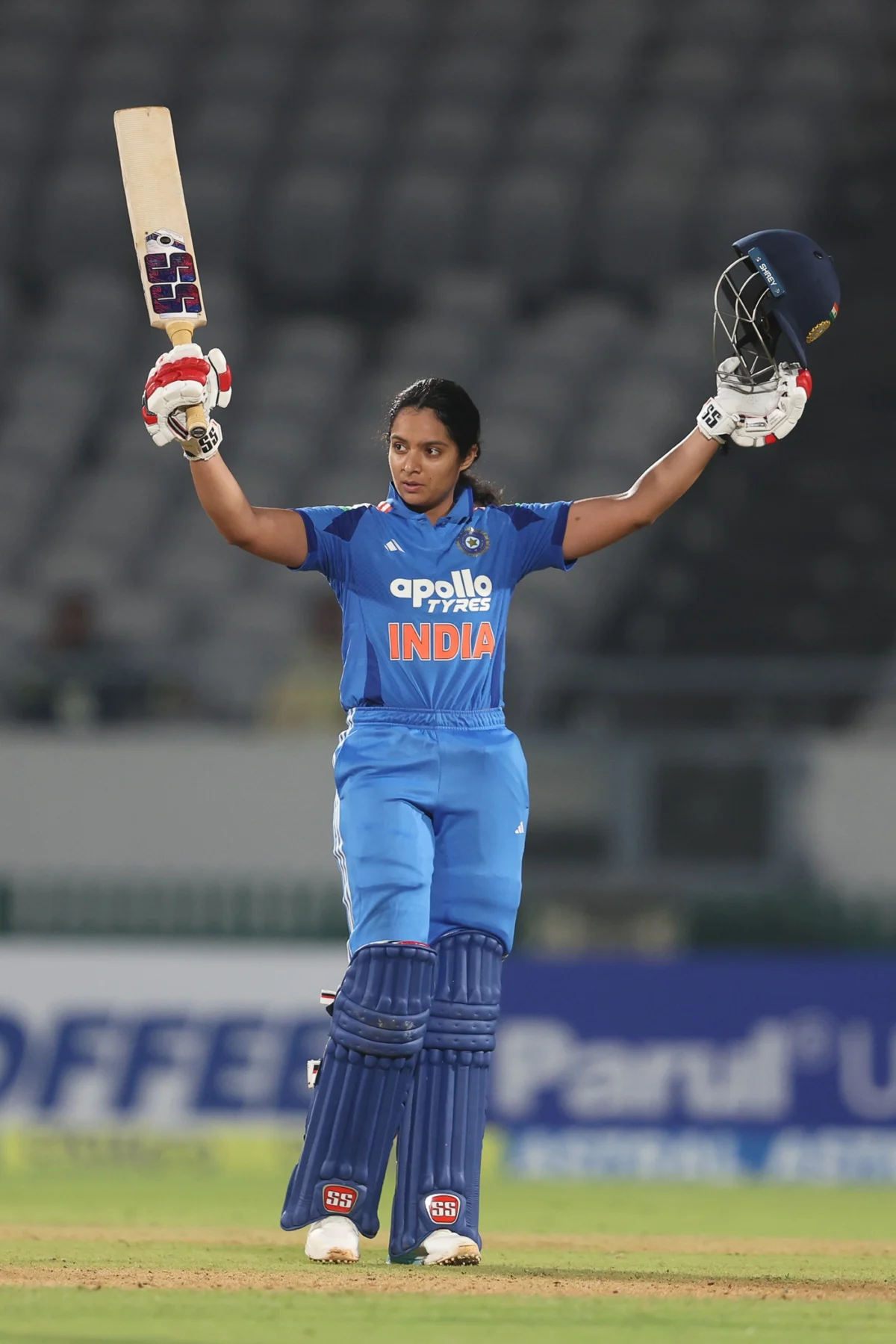
India opener Pratika Rawal has revealed that she has actively worked on finding more boundaries during the powerplay, aiming to fully capitalize on the fielding restrictions in the opening ten overs of an ODI innings. Currently starring as the leading run-getter in the ongoing ODI series against Zimbabwe with scores of 100 not out and 61, Rawal is determined to evolve her game by enhancing her scoring rate and taking inspiration from her captain, Smriti Mandhana.
Speaking in Vadodara ahead of the third ODI, Rawal reflected on her evolution as an international cricketer and the tactical adjustments she has introduced to her batting approach. The more matches she has played over the years, the better she has come to understand the nuances of the game. According to the opening batter, her recent progress is a direct result of adapting her game, studying her own batting patterns, and carefully analyzing the tactics deployed by opposing bowlers.
Recognizing the tactical advantage presented by the initial phase of an innings, Rawal noted that she specifically targeted improving her powerplay scoring. Because only two fielders are permitted outside the thirty-yard circle during the first ten overs, she recognized a clear opportunity to generate momentum and find the boundary with greater frequency.
Rawal has established herself as India’s preferred choice at the top of the order alongside captain Smriti Mandhana since the previous year. However, despite her reliability and immense run-scoring volume, she has frequently faced external scrutiny regarding her strike rate. During the 2025 calendar year, Rawal amassed 976 runs, placing her third on the list for the most runs scored in women’s ODIs for that period. Yet, those runs came at a strike rate of 83.99. In contrast, Mandhana finished as the leading ODI run-getter last year, accumulating 1,362 runs while maintaining a brisk strike rate of 109.92.
Observing Mandhana’s approach from the non-striker’s end has provided Rawal with a masterclass in modern limited-overs batting. Witnessing her captain operate at such a high level naturally inspires a desire to emulate those methods. Rawal expressed her admiration for Mandhana’s template, noting that when you see Smriti batting at the other end, you feel there is a lot to learn and an urge to replicate what she does at her best. Rawal remains optimistic that through continued hard work and application, she will eventually reach that desired level of scoring efficiency.
Recent performances suggest that these technical and mental adjustments are already bearing fruit. During her fluent century in the opening match of the series against Zimbabwe, Rawal displayed a noticeably more aggressive intent by striking seven boundaries inside the first powerplay alone, racing to 43 runs off 37 balls. This represented a stark contrast to her previous century, which came exactly a year prior against New Zealand during the World Cup. In that fixture, she managed only three fours in the first ten overs, compiling 15 runs off 33 balls. Throughout India’s successful World Cup campaign, Rawal hit a total of just 18 boundaries in the powerplay, scoring at a strike rate of 70.3 during the initial phase.
The stability of her position at the top of the order has also provided important mental clarity. Rawal retained her opening partnership with Mandhana even when Shafali Verma was initially dropped from the ODI squad last year, creating a successful left-right combination at the pinnacle of the batting lineup throughout the World Cup campaign. An untimely ankle injury later opened the door for Shafali to reclaim a spot in the side, an opportunity the explosive youngster seized by crafting a brilliant 78-ball 87 in the tournament’s final against South Africa.
Prior to the current assignment against Zimbabwe, India had fielded an ODI playing eleven featuring Rawal, Mandhana, and Shafali simultaneously on only one occasion, during an encounter against Australia in February, where Shafali contributed four runs. In the subsequent tactical shift seen during the first ODI in Vadodara last Friday, Shafali slotted comfortably into the number three position, punishing the opposition bowling attack with an unbeaten 64 off 33 deliveries.
Addressing any external speculation surrounding the team selection and batting hierarchy, Rawal clarified that there were no anxious discussions within the dressing room regarding positions. She emphasized that she and Mandhana were entirely clear on their roles as openers, while Shafali was similarly aware of her assignment at first drop, mirroring the exact structure utilized during the preceding tour of Australia. Rawal maintained that the batting order was never a source of internal distraction or doubt, allowing her to walk out to the middle with a completely unburdened mindset focused squarely on fulfilling her duty as an opener for the Indian team.
Rawal’s current form in the Zimbabwe series follows her campaign with the Indian side at the women’s Asia Cup held in Dubai last month. Upon returning home from that tournament, her immediate priority was to re-establish her foundational batting habits by logging extended periods at the crease. Recognizing the distinct demands of the longer 50-over format, she focused heavily on cultivating patience, particularly against flighted deliveries, and learning to rotate the strike efficiently to construct a sustainable innings. Spending extended hours in the nets instilled a deep sense of confidence, reinforcing her timing and ensuring that all other facets of her batting fell naturally into place.


Comments (0)